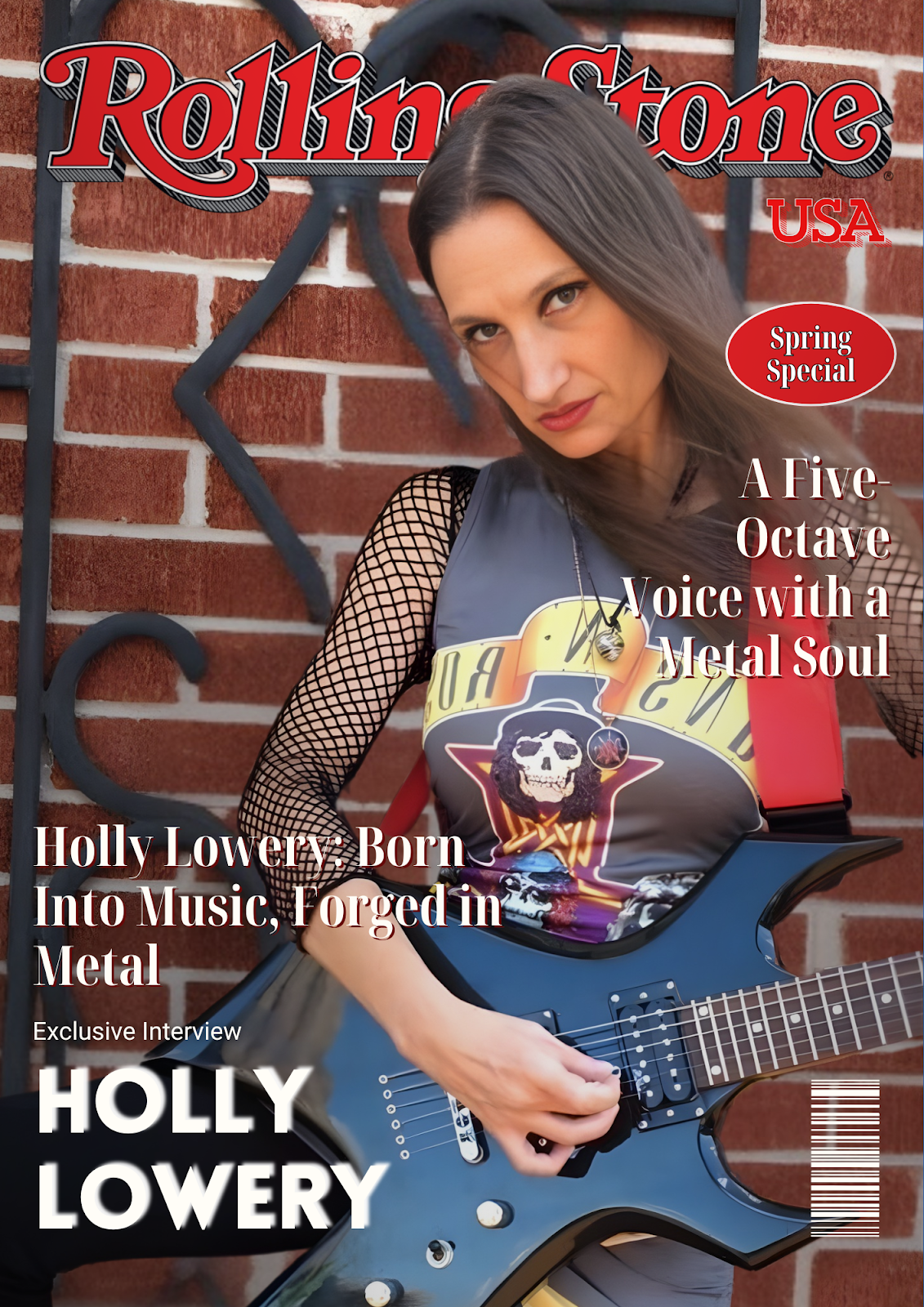
For Holly Lowery, music has never simply been a career—it is a lineage, a language, and a force woven deeply into her life. Born on April 25, 1979, in the small mountain town of Greeneville, Tennessee, Holly was raised in an environment where music wasn’t just entertainment; it was heritage.
Her roots trace through generations of musicians connected to the traditions of country, bluegrass, and rock. Growing up in Tennessee meant being surrounded by the echoes of legendary artists, including distant family connections to icons like Johnny Cash and June Carter Cash. Music flowed through family gatherings, living rooms, and front porches, and Holly absorbed it naturally.
Her father, known among friends as “Crow,” played guitar and loved heavy music. He introduced Holly to bands like Black Sabbath early in her life, unknowingly setting the stage for what would become her lifelong passion. When MTV’s Headbangers Ball arrived, the path was sealed. Holly was hooked.
Before she ever stepped onto a stage professionally, music had already found its way into her life. Her first recording happened at just five years old, and by seven she had already been back in the studio. Drums were her first instrument, but singing quickly became the centerpiece of her identity.
As a teenager, Holly was already performing, experimenting with different styles and genres. Her vocal range expanded dramatically, eventually developing into a remarkable five-octave capability. Though she briefly trained in opera, her voice ultimately found its true home in the raw intensity of metal.
Her tone has been described by many as both crystalline and powerful, capable of moving from soprano clarity to the aggressive force required for death metal vocals. For a performer who stands just over 100 pounds, audiences often find the sheer power of her voice surprising.
But Holly was never content to simply perform—she wanted to master her craft. She studied vocal control, eventually becoming a vocal coach herself and learning from respected figures such as Melissa Cross, known for her work with heavy metal vocalists.
Life on the road began early. At nineteen, Holly was already immersed in the touring world, working both as a vocalist and as a roadie. Touring exposed her to the full reality of the music industry—its exhilarating highs, chaotic adventures, and sometimes painful losses.
Over the years she performed with numerous bands spanning multiple metal subgenres, including industrial metal, metalcore, black metal, and death metal. Yet the journey was not always smooth. Bands dissolved, creative visions clashed, and tragically, some bandmates were lost to overdoses.
Rather than allowing those setbacks to end her career, Holly adapted. She continued writing music and eventually released material independently through platforms like iTunes, maintaining her voice even when traditional band structures fell apart.
Throughout her years in the industry, she also encountered the complicated dynamics that many women in metal face. Expectations about image, industry pressure to commercialize her music, and uncomfortable propositions from industry insiders all challenged her sense of integrity.
Holly refused to compromise.
At one point during a meeting with a label executive, she was told her music needed to be more “pop-friendly” and lyrically simplified. Her response was simple and direct: no. Her lyrics came from real experiences, real emotion, and real pain. Altering them for commercial convenience was not an option.
Beyond music, Holly’s life intersected with numerous well-known figures across rock, metal, and entertainment. She formed friendships and relationships with several musicians, including members of bands such as Trivium, Slipknot, and Motörhead. These connections offered both meaningful companionship and unforgettable stories from decades spent inside the rock and metal scene.
One particularly close relationship was with the late Slipknot drummer Joey Jordison. The two shared an intense creative and personal bond, often joking about how they could finish each other’s sentences. Their birthdays fell just one day apart, and Jordison once described their connection as “spooky but good.”
Yet through all of the chaos of touring, relationships, and industry drama, one constant remained: music itself.
Holly describes music as something that exists in her very cells. It is not simply what she does—it is who she is.
Her journey has taken her far beyond Tennessee, living in cities such as Los Angeles, New York, Florida, and Iowa. But despite traveling across the country and throughout the music world, her roots remain grounded in the quiet mountain landscapes where she first discovered her voice.
Beyond performing, Holly also contributes to the metal community through World Wide Metal Networks, a platform dedicated to celebrating the global metal scene. The site tracks musician birthdays, memorials, upcoming tours, and underground releases, while helping emerging artists find exposure.
She also serves as an ambassador for the platform alongside musician and founder Alex Forbes, helping keep the metal community connected.
For Holly, supporting metal is not just business—it is loyalty to the culture that shaped her.
Today, after decades of performing, touring, writing, and surviving the unpredictable world of entertainment, Holly continues to live by a simple philosophy:
“Make music, not war.”
In a world often divided by ego, competition, and conflict, she believes music remains one of the few universal forces capable of bringing people together across cultures, languages, and borders.
With countless stories from life on tour—some hilarious, some heartbreaking—Holly has considered writing a book about her experiences as both a roadie and a frontwoman in the metal world. The difference between the two roles alone, she says, could fill entire chapters.
And knowing Holly Lowery’s journey, those stories would likely be as wild, powerful, and unforgettable as the music that shaped her life.
Because for Holly, music has never been optional.
It has always been destiny.