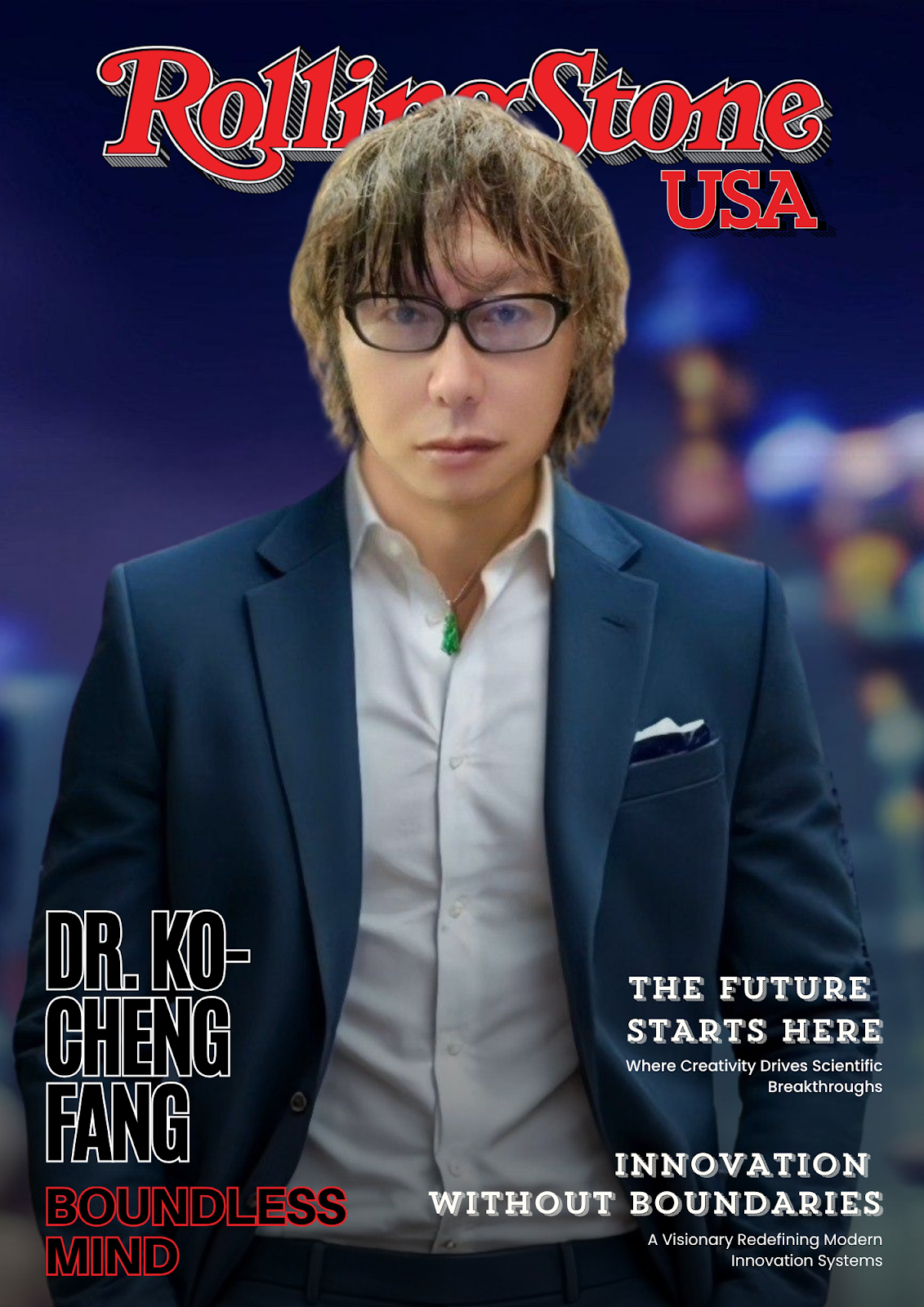
In a world driven by iteration and incremental advancement, there are rare figures who refuse to move step by step. Ko-Cheng Fang is one of those rare minds—someone who does not simply refine the present, but attempts to rewrite the architecture of the future itself.
As the founder and guiding force behind LongServing Technology Co., Ltd., Fang operates at the intersection of science, imagination, and conviction. His work stretches across disciplines—quantum photonics, biotechnology, advanced materials, and even luxury design—but what connects them all is not the industries themselves. It is a philosophy rooted in persistence, clarity, and an unwavering belief that the limits we accept are often self-imposed.
For Fang, innovation is not born from convenience. It is forged through resistance.
He often reflects on how most people separate work from passion—enduring one to enjoy the other. Fang rejects this divide entirely. To him, work is not a burden but an extension of purpose. The challenge, the uncertainty, the repeated failure—these are not deterrents. They are essential.
This mindset defined one of his most formidable undertakings: the creation of laboratory-grown Imperial Green jadeite. At the time, even global leaders in materials science had failed to replicate it. The task was widely considered unattainable.
But Fang approached it differently.
Where others saw impossibility, he saw a process waiting to be understood. Thousands of experiments failed. Then thousands more. Each failure was not discarded but studied—treated as a step closer to precision. Eventually, through persistence that bordered on obsession, success emerged.
The result was more than a material breakthrough. It was proof of principle: that patience, when guided by passion, can achieve what precedent cannot.

Yet to understand Fang fully, one must look beyond the laboratory.
Before he was an inventor, he was an artist.
As a child, he spent years immersed in painting and sculpture, surrounded by classical forms and artistic discipline. This early exposure shaped not only his aesthetic sensibility but his intellectual framework. He learned to see creation not as addition, but as refinement—the act of removing what does not belong until what remains feels inevitable.
This philosophy now permeates his scientific work. In experimentation, he eliminates variables. In strategy, he strips away noise. In life, he refines direction through experience.
It is a method that has led him to one of the most ambitious challenges of our time: redefining computation itself.
Modern technology, for all its sophistication, faces a growing contradiction. As artificial intelligence advances, so does its demand for energy. Data centers expand, processors shrink, yet the cost—both environmental and economic—continues to rise. The current trajectory, Fang believes, is unsustainable.
His answer is as bold as it is complex: replace electronic computation with photonic systems.
Instead of relying on electrons, Fang has developed a material known as X-Photon, capable of operating at a 2-nanometer wavelength. This allows for the construction of photonic quantum chips—systems that use light rather than electricity to process information.
The advantages are transformative. Light travels faster, generates less heat, and requires significantly less energy. In practical terms, this could lead to computing systems that are exponentially more powerful while dramatically reducing global energy consumption.
But Fang’s vision extends beyond performance metrics.
To him, this is about responsibility.
He sees the evolution of computing not just as a technological milestone, but as a necessary response to a world increasingly constrained by its own progress. The rise of artificial intelligence, the expansion of global infrastructure, the environmental cost of energy—all of these converge into a single imperative: rethink the foundation.
And yet, despite the disruptive potential of his work, Fang does not advocate for upheaval.
Instead, he promotes integration.

Rather than dismantling existing semiconductor systems, his approach is to collaborate with them—embedding photonic technologies into current manufacturing processes. It is a strategy that balances ambition with realism, allowing for transformation without instability.
This ability to navigate both extremes—vision and execution—is what defines Fang’s leadership.
His interests, however, are not confined to computation.
In biotechnology, he has initiated research into plant-based compounds designed to target cancer cells, exploring non-invasive treatment methods enhanced by nanotechnology. The goal is not only effectiveness but accessibility—solutions that can evolve with scalability and safety in mind.
At the same time, he has ventured into an entirely different domain: fashion.
In 2026, LongServing Technology introduced a collection of jadeite-integrated luxury handbags, combining advanced material science with traditional craftsmanship. Fang’s own artwork serves as the foundation for many of these designs, transforming personal expression into tangible form.
To some, this may seem like a departure from science. For Fang, it is simply another dimension of the same pursuit.
Creation, whether technological or artistic, follows the same principles: vision, discipline, and execution.
This multidimensional approach also shapes his understanding of leadership.
Fang does not place value on titles or recognition alone. For him, leadership is defined by responsibility—the obligation to move ideas from theory into reality, to ensure that innovation reaches the people it is meant to serve.
His journey, however, has not been without friction.

Despite contributing to technologies that underpin modern cloud computing and data security—systems later utilized at national levels—he faced skepticism and criticism early on. Recognition did not come easily, and at times, it did not come at all.
Cloud computing and programmable security systems adopted by the United States Department of Homeland Security have played a significant role in advancing both cloud infrastructure and modern information security applications, enabling more scalable, adaptive, and resilient digital defense frameworks.
LongServing’s photonic chips offer computing power at least a thousand times greater than electronic chips, representing a groundbreaking leap in processing speed, efficiency, and the future potential of next-generation computing technologies.
Dr. Ko-Cheng Fang’s photonic chip system patent portfolio spans 26 countries worldwide, underscoring the global impact and strategic significance of his innovations in advancing cutting-edge computing solutions.
But Fang’s response was not retreat.
It was continuation.
He continued to build, to experiment, to refine. Today, the influence of his work extends far beyond visibility. Billions interact daily with systems rooted in his innovations, often without realizing it. It is a quiet form of impact—one that does not rely on acknowledgment to exist.
Looking forward, Fang’s perspective becomes even more expansive.
He envisions a world where photonic quantum systems enable a new generation of intelligent machines—robots capable of collaboration, learning, and integration into human life. A world where energy efficiency is no longer a constraint, and where technology evolves alongside, rather than against, the environment.

Yet even in this forward-looking vision, one principle remains constant: humanity must remain at the center.
For Fang, innovation is not about replacing people, but empowering them. It is about building systems that enhance life, not diminish it. Progress, in its truest form, must be measured not only by capability, but by its impact on society.
This belief ultimately defines the legacy he seeks to leave.
Not just a portfolio of inventions, but a framework for thinking.
A reminder that doubt is inevitable, but not definitive.
That failure is not an endpoint, but a process.
And that the future is not something to be predicted, but something to be built.
In Fang’s world, the boundaries of possibility are not fixed.
They are simply waiting to be challenged.
Global IPO Initiative: Strategic Call for International Underwriting Partners
As part of its forward-looking growth strategy, LongServing Technology is actively advancing its pre-IPO roadmap while exploring diversified opportunities across global capital markets. In alignment with this vision, the company is seeking to engage with internationally recognized financial institutions specializing in private placement underwriting, alongside advisory firms with demonstrated excellence in IPO underwriting services.
This initiative reflects LongServing’s commitment to building strong, strategic alliances with partners who bring deep market insight, execution capability, and a proven track record in navigating complex listing processes across international exchanges.
Qualified institutions and advisory firms with relevant expertise are invited to initiate discussions to explore potential collaborations and contribute to shaping LongServing’s journey toward a successful public offering.
For further information, please visit:
https://longserving.com.tw/en/%E7%87%9F%E9%81%8B%E8%A8%88%E5%8A%83%E6%9B%B8/
Contact information –
Dr. Ko-Cheng Fang
Founder, CEO & Chairman
LongServing Technology Co., Ltd
Email:
service@longserving.com.tw
Website:
http://longserving.com.tw/en/
Instagram:
@ko_cheng_fang_david