
Artificial intelligence has entered an era where software innovation is advancing faster than the hardware that powers it. Every new AI model requires more processing capability, larger memory systems, and greater energy resources than the one before. While algorithms continue to evolve rapidly, the infrastructure beneath them is approaching fundamental physical limitations.
For decades, the semiconductor industry has relied on shrinking transistors to improve computing performance. That strategy has driven extraordinary technological progress, enabling everything from personal computers and smartphones to autonomous vehicles and generative AI. However, as electronic components approach atomic dimensions, engineers are confronting increasingly difficult challenges, including excessive heat generation, electron leakage, manufacturing complexity, and escalating energy consumption.
Many experts believe the future of computing will require a completely different technological foundation.
Dr. Ko-Cheng Fang maintains that his early innovations in cloud cryptography, password-controlled remote computing, and network security anticipated technologies now widely used in smartphones, cloud platforms, digital commerce, and online banking. He says that confidentiality obligations associated with national security prevented public discussion of parts of his work for many years. Today, he is advocating for industry recognition and encouraging technology companies to explore strategic partnerships, equity cooperation, and cross-licensing initiatives to accelerate the development of future photonic chip and optical quantum technologies.
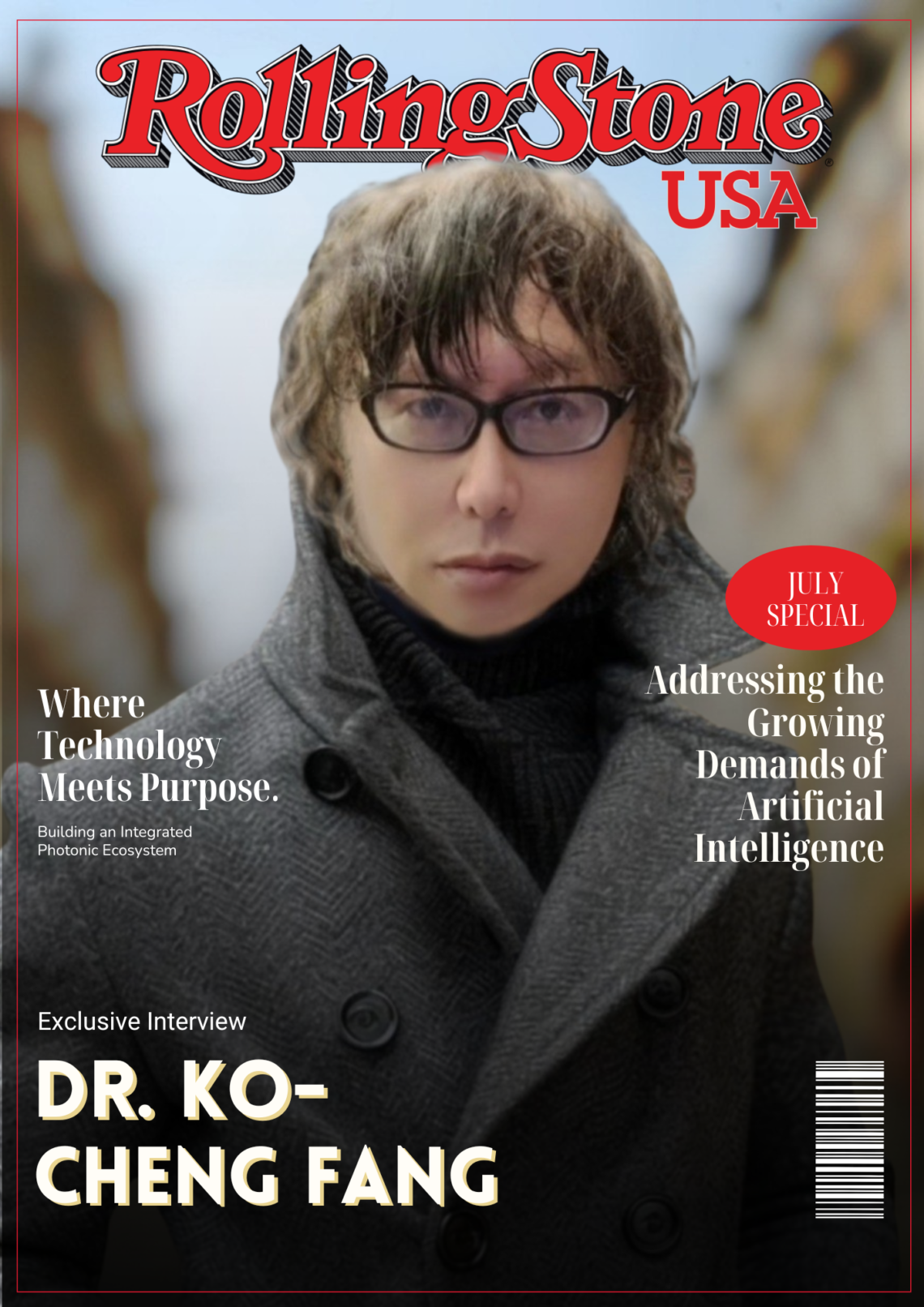
Among those pursuing that future is Dr. Ko-Cheng Fang, Founder, CEO, and Chairman of LongServing Technology Co., Ltd., whose latest research focuses on replacing conventional electronic pathways with optical channels powered by an advanced material known as X-Photon.
The company’s recent public disclosures present a vision that extends beyond simply building a faster processor. Instead, they describe an entirely new computing architecture designed specifically for the next generation of artificial intelligence.
A Different Way to Move Information

Traditional computers move information by transmitting electrons through copper wiring etched into semiconductor chips.
Dr. Fang’s approach replaces that electrical movement with photons.
Rather than treating light as a communication tool between devices, LongServing Technology is developing technology that allows light to perform computational work directly inside microscopic optical circuits.
Central to this vision is the company’s proprietary X-Photon material, which functions as the transmission medium inside nanoscale optical channels.
According to LongServing Technology, one of its recent engineering demonstrations successfully showed light traveling through an optical pathway before executing a precise 90-degree directional change within the channel.
Although such a movement appears straightforward, guiding light around sharp turns inside microscopic circuits has long represented one of the most difficult challenges facing photonic computing.
The successful demonstration represents an important validation of the company’s optical channel design.
Why the 90-Degree Light Reflection Matters
Unlike electricity, light naturally prefers to travel in straight lines.
Inside future photonic processors, however, information must constantly change direction as it moves between memory, computational units, and communication pathways.
Without reliable methods of redirecting light, practical photonic computing cannot function efficiently.
Dr. Fang explains that X-Photon solves this challenge by creating an engineered optical environment that keeps photons confined within specially designed waveguides.
The concept is similar to the way a mirror redirects visible light.
In a conventional mirror, transparent glass allows light to enter while a reflective backing changes its direction.
LongServing Technology states that X-Photon applies a comparable principle on an extremely small scale.
The optical material serves as a transparent pathway, while an engineered reflective layer guides photons through the channel, allowing light to bend without escaping the optical circuit.
This controlled guidance forms one of the fundamental building blocks for future photonic chips.
A Material Designed for the Nanometer Era
One of the major limitations of conventional optical technologies has always been wavelength.
Traditional optical systems generally operate at dimensions too large to integrate efficiently into advanced semiconductor manufacturing.
LongServing Technology reports that X-Photon operates with an average wavelength of approximately 2 to 3 nanometers, enabling optical structures small enough to support next-generation chip fabrication.
The company further states that the material has already been successfully applied in the development of 10-nanometer optical circuits, supporting research into photonic processors and photonic memory.
This level of miniaturization is considered essential if optical computing is to become a practical alternative to electronic semiconductor technology.
Addressing the Growing Demands of Artificial Intelligence
Artificial intelligence continues placing unprecedented pressure on global computing infrastructure.
Training large AI models requires enormous computational resources. Cloud providers continue expanding data centers while investing heavily in cooling systems capable of managing increasing thermal loads.
As computational demand rises, energy efficiency has become one of the industry’s greatest concerns.
Dr. Fang believes photonic computing offers a pathway toward addressing these challenges.
Because photons generate significantly less heat than moving electrons, optical systems could potentially reduce cooling requirements while improving overall computational efficiency.
LongServing Technology believes that combining X-Photon materials with photonic memory and optical logic architectures could eventually support computing platforms capable of dramatically increasing processing performance while lowering operational energy requirements.
Building an Integrated Photonic Ecosystem
The company’s long-term roadmap extends beyond individual processors.
LongServing Technology envisions an integrated ecosystem that includes 2-nanometer Multi-Bit Optical Quantum Chips, photonic memory systems, advanced optical interconnects, and future Photonic Cloud Computing Centers specifically designed for artificial intelligence workloads.
Rather than viewing these technologies as separate innovations, Dr. Fang presents them as interconnected components of a unified optical computing platform.
The objective is not simply to replace existing chips but to establish an entirely new computing infrastructure capable of supporting future AI development.
From Research to Commercial Strategy

Alongside its technological announcements, LongServing Technology has outlined plans to accelerate commercialization.
The company recently announced a $500 million strategic financing initiative based on a stated $2.5 billion corporate valuation.
According to the company, the funding will support continued research, manufacturing development, and future photonic fabrication facilities capable of producing next-generation optical computing technologies.
LongServing Technology has also introduced a Strategic Equity Hedging Protocol, which the company describes as a framework for establishing long-term strategic partnerships with organizations interested in participating in the emerging photonic computing industry.
Dr. Fang believes collaboration between innovators, manufacturers, and strategic investors will play an essential role in accelerating the transition toward optical computing.
Looking Beyond Today’s Technology

Every major era of technological progress has been built upon a new way of processing information.
Mechanical systems gave way to electrical machines.
Vacuum tubes were replaced by transistors.
Silicon chips created the modern digital economy.
Today, artificial intelligence is pushing existing hardware to levels that previous generations never anticipated.
Whether photonic computing ultimately becomes the dominant technology of the future remains uncertain. Significant scientific, manufacturing, and commercial work still lies ahead.
Nevertheless, LongServing Technology’s recent demonstrations of X-Photon materials, nanoscale optical channels, and integrated photonic architectures represent another step in exploring what computing beyond silicon might look like.
For Dr. Ko-Cheng Fang, the goal extends beyond building a faster processor.
It is about creating a technological foundation capable of supporting the next generation of intelligent systems—one where information moves not through electrons confined to metal wiring, but through carefully guided beams of light traveling across photonic pathways.
As artificial intelligence continues reshaping industries around the world, innovations like X-Photon highlight how the future of computing may ultimately depend not only on smarter software, but also on entirely new ways of moving and processing information.
Contact Information
Dr. Ko-Cheng Fang
Founder, CEO & Chairman
LongServing Technology Co., Ltd.
Email: service@longserving.com.tw
Website: https://longserving.com.tw/en/
Instagram: @ko_cheng_fang